Technical SEO involves optimizing your website’s technical aspects to improve its search engine ranking. This includes enhancing site speed, mobile-friendliness, security, and ensuring search engines can crawl and index your site effectively. In this article, you’ll learn the key components of what is technical SEO and practical tips for implementation.
Key Takeaways
-
Technical SEO focuses on optimizing a website’s technical aspects such as crawlability, indexing, and site speed to improve search engine rankings and enhance user experience. Other search engines also prioritize these factors, making it crucial to optimize for all search engines, not just Google.
-
Key elements of technical SEO include maintaining proper website structure, addressing duplicate content through canonical and noindex tags, and ensuring mobile optimization and website security.
-
Regular use of technical SEO tools like Google Search Console, Screaming Frog, and PageSpeed Insights is essential for monitoring site performance, identifying issues, and maintaining overall technical health.
Understanding Technical SEO

Technical SEO encompasses the optimization of your site’s technical elements to elevate its position in search engine results. This critical infrastructure underpins successful content marketing and link-building approaches. When websites seem to ascend effortlessly in search rankings, their adeptness at technical SEOs is usually a key reason.
Central to the concerns of technical SEO is optimizing your website’s structural attributes so that it becomes more accessible for search engines to discover, crawl, render, and catalogue its pages. Ensuring that search engines index your content correctly is crucial for avoiding duplicate content issues and improving the relevance of search results. Achieving this means assuring your website has robust security measures, responsive design for mobile devices, and quick loading times—essential components aligning with Google’s Core Web Vitals criteria—and such enhancements can substantially increase both visibility and placement within search listings.
For e-commerce platforms dealing with extensive page volumes requiring detailed keyword implementation strategies specifically stands out as an indispensable application of technically sound SEO practices. These methods are vital not only for amplifying performance across various search engines, but also for advancing overall user experience – a shift leading directly towards heightened organic visitor influxes alongside improved conversion metrics.
Definition of Technical SEO
Technical SEO refers to the process of optimizing a website’s technical aspects to improve its visibility, crawlability, and indexing by search engines. It involves ensuring that a website meets the technical requirements of search engines, such as Google, Bing, and Yahoo, to improve its search engine rankings and drive more organic traffic.
Technical SEO encompasses a variety of elements, including site speed, mobile-friendliness, security, and structured data. By addressing these technical aspects, you ensure that search engines can efficiently crawl and index your site, leading to better search engine rankings. This foundational work is crucial for any successful SEO strategy, as it lays the groundwork for other SEO efforts like content creation and link building.
Key Elements of Technical SEO
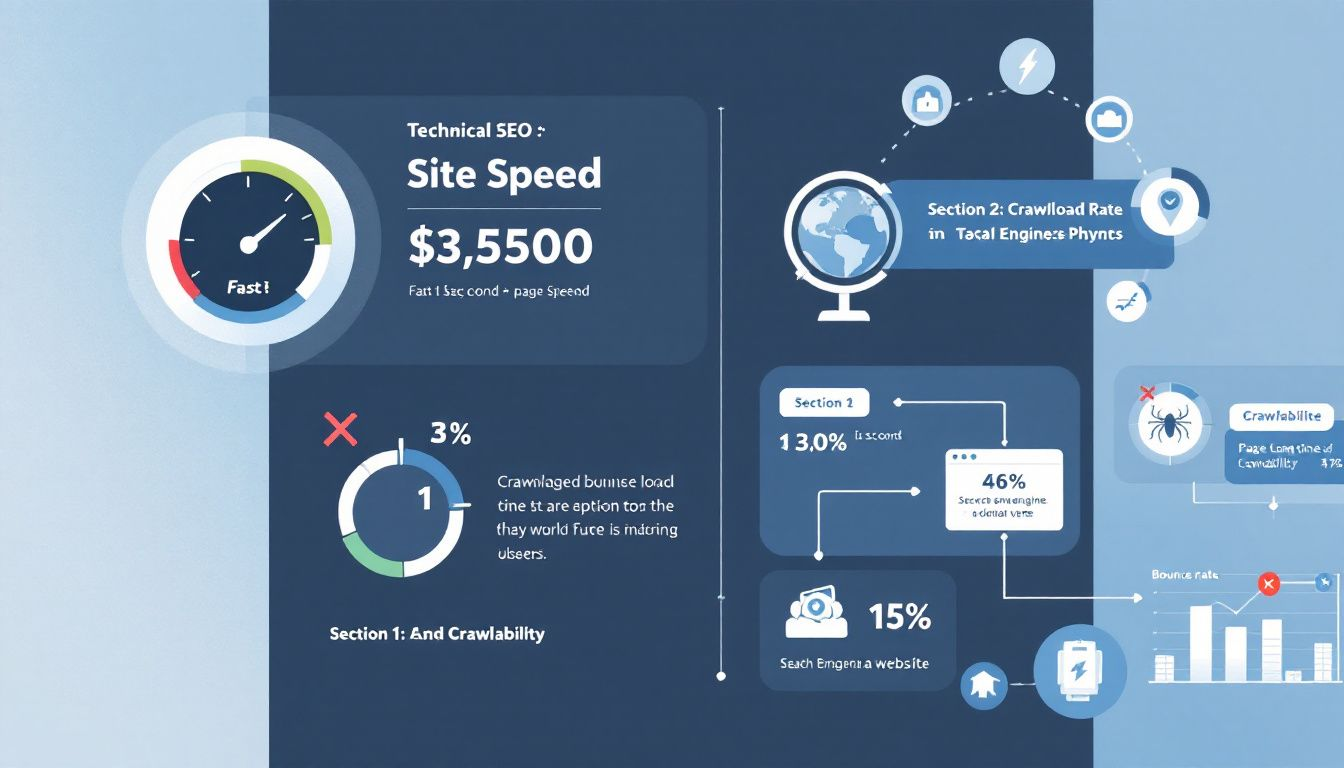
To master technical SEO, it’s essential to understand its core components: crawlability, indexing, and site speed. These elements are the backbone of a well-optimized website, ensuring that search engines can efficiently discover, interpret, and rank your content.
Crawlability refers to the ability of search engines to navigate your website and find new pages. Search engines need to crawl your site before they can index it, making this the first step in the SEO process. Properly managing redirects and canonicalization ensures that search engines index and rank the correct version of content, which helps avoid duplicate content issues that can harm rankings.
Indexing, on the other hand, involves storing and organizing your website content in search engine databases, making it available for search queries. Lastly, site speed is a critical factor that affects user experience and search engine rankings. A fast-loading website not only keeps visitors engaged, but also signals to search engines that your site is well-maintained and user-friendly.
Crawlability
The cornerstone of technical SEO is ensuring your website can be crawled. If search engines are unable to find or catalog your web pages, they won’t appear in search results. Proper crawlability ensures that search engines index your content effectively, improving its relevance in search results. Search engines must follow links from existing pages to discover new ones, making crawlability crucial for high visibility in search rankings.
A significant component that aids search engines in locating the correct pages on your site is an XML sitemap. It enumerates all URLs available on your website and includes vital metadata regarding each URL, which assists search engines with the navigation of your site’s structure. A robots.txt file serves as a directive for what areas of your website should be explored by the crawlers and which sections should be excluded.
To ensure persistent crawlability, one must promptly remedy any detected crawl errors and keep them under surveillance. Submitting an XML sitemap directly to Google can substantially benefit larger websites or those with fewer backlinks — it’s especially useful when looking to enhance indexing efficiency for these types of sites. Validating XML sitemaps regularly ensures that every link directs to an active page contributing to more effective indexing efforts by the crawlers.
Indexing
The indexing process enables search engines to catalogue the content of your website. Proper indexing ensures that search engines index your pages accurately, improving their relevance in search results. It is essential because only pages that are indexed will show up in search results. Tools such as Google Search Console play a pivotal role in tracking how well your site is being indexed and spotting problems that might stop pages from being properly catalogued.
To verify whether or not your webpages have been indexed, you can use the ‘site:’ command within a search engine. This function reveals the count of currently-indexed site pages, providing an immediate insight into your indexation status. Google Search Console offers detailed reports on page indexing which shed light on any difficulties Google may encounter when trying to fully index or render certain pages.
Structured data serves as a critical means for boosting indexing efficiency by coding information in a way that clarifies page contents for search engines, thus enhancing their likelihood to be both indexed and favorably ranked. Given the prevalence of mobile-first indexing with Google, it’s increasingly crucial to ensure that mobile versions of sites are thoroughly optimized for these considerations.
Site Speed
The speed of a website plays a pivotal role in enhancing both the satisfaction of its users and its position in search engine results. A swiftly loading site captivates visitors, diminishing the likelihood that they will leave prematurely. Tools such as PageSpeed Insights are instrumental in examining how quickly your site loads while identifying elements that may be causing delays.
To bolster user engagement and decrease instances where users abandon your site, it’s vital to improve load times for pages. This can be done through actions like file compression to reduce their size, employing asynchronous script loading methods, and fine-tuning high-definition images for quicker downloads. It’s also crucial to consistently review redirects to ensure they don’t adversely affect page speed or the overall experience for your audience.
Utilizing PageSpeed Insights allows you access to an evaluative performance score between 0 and 100. This helps gauge how fast your website operates and directs attention to areas needing enhancements. Testing your webpage on platforms such as webpagetest.org provides deeper understanding into performance metrics including how effectively content delivery networks (CDNs) are functioning with regard to speeding up content distribution across different geographical locations.
Enhancing Website Structure
Having a meticulously organized structure for your website is essential for enhancing user experience and search engine optimization (SEO). This organization facilitates the process by which search engines crawl and index the content on your site, guaranteeing its accessibility. Properly managing redirects and canonicalization ensures that search engines index and rank the correct version of content, which helps avoid duplicate content issues that can harm rankings. It simplifies various technical SEO tasks.
It’s vital to pay attention to broken links as part of preserving a robust site structure. These broken links can harm both the user experience and your standing in search engine rankings. Regularly detecting and resolving them is of paramount importance.
Organized Site Structure
For enhanced crawlability and indexing, it’s advised to maintain a flat structure for your site. This entails having all pages accessible within just a few clicks from the homepage, simplifying navigation for users and search engines alike. Properly structured data markup can help search engines index your website more effectively, resulting in improved relevance of search results. The addition of breadcrumbs menus can improve this navigational experience while also aiding search engines in grasping the layout of your website.
Another critical action is the construction of XML sitemaps. These act as maps that lead search engines across your website, guaranteeing that every significant page gets indexed. You can employ tools such as Screaming Frog to examine the structures of your URLs and pinpoint any issues related to technical SEO.
Internal Linking
Employing internal linking is a potent strategy to define your website’s structure and elevate its search engine optimization. By creating links to essential content, you significantly increase its exposure and traffic levels. Effective internal linking strengthens credibility with search engines while providing users with more intuitive site navigation, thus enhancing the value that each internal link brings. Additionally, internal linking helps search engines index your website more effectively, ensuring that all important pages are properly recognized and ranked.
It’s vital to incorporate anchor text rich in keywords when establishing internal links to boost their relevance. Conducting regular SEO check-ups allows for the detection and repair of any broken internal links, which ensures a fluid user experience without interruptions. It is important to address orphan pages—those lacking incoming links from other parts of your site—to prevent confusion among visitors and potential negative impacts on your website’s optimization process.
Strategically placing internal links from pages with high authority onto significant but deeper webpages guarantees their indexing by search engines and enhances their ranking prospects. Such tactics aid in evenly distributing link equity throughout your entire domain, resulting in heightened overall SEO effectiveness.
Addressing Duplicate Content
The presence of duplicate content on your site can lead to confusion for search engines, which may harm the indexing and ranking of your website. Properly managing redirects and canonicalization ensures that search engines index and rank the correct version of content, helping to avoid duplicate content issues that can harm rankings. This issue often arises from having several URLs that point to identical content or using different parameters to cater to regional differences. To avoid such problems, it is vital that each page on your website features unique and fresh content.
To handle issues related to duplicate content efficiently, employing canonical tags and noindex tags serves as a practical solution. These mechanisms aid search engines in recognizing which version of a page should be prioritized while also stopping them from indexing pages with duplicated material.
Canonical Tags
Canonical tags serve to signify the principal variant of pages that appear multiple times, thereby guiding search engines towards the version you wish them to prioritize. This practice is vital for steering clear of complications related to duplicate content and fortifying your backlink profile. Proper use of canonical tags ensures that search engines index the correct version of your content, enhancing the relevance of search results.
By meticulously handling redirects and employing canonicalization, one can avert penalties linked with redundant content while boosting their website’s position in search rankings. The use of canonical tags contributes to preserving an organized and streamlined site structure by designating which page rendition ought to be cataloged by search engines.
Noindex Tag
The noindex tag serves as an instruction for search engines, indicating that they should not index a certain page. Properly managing the noindex tag ensures that search engines index and rank the correct version of content, which helps avoid duplicate content issues that can harm rankings. It proves to be especially beneficial when it comes to controlling the visibility of pages that are not crucial, including category and tag pages on WordPress sites.
Using utilities such as Yoast simplifies the process of implementing the noindex tag on these kinds of pages. This action aids in averting issues related to duplicate content and enhances your website’s indexing methods. By guiding search engine bots towards more pertinent content, this tactic contributes positively to enhancing the general performance of searches on your site.
Optimizing for Mobile and Security

In the current digital environment, optimizing for mobile and focusing on security are crucial components of technical SEO. Considering that mobile devices account for more than half of global internet traffic, with a figure over 53%, it is vital to make sure your website caters effectively to this growing user base. By incorporating mobile optimization into your broader technical SEO strategy, you can substantially improve the performance of your site.
The significance of security cannot be overstated either. The transition to HTTPS does not only safeguard confidential user data, but also has beneficial effects on search rankings. Establishing a secure website fosters trust among both users and search engines, which in turn aids in achieving better SEO results.
Mobile Usability
Capturing and maintaining traffic from mobile users is essential, and utilizing instruments such as Lighthouse along with PageSpeed Insights can assist in pinpointing and resolving issues related to mobile usability. An effective design for mobile prioritizes succinct navigation and critical functionality directly on the page.
Given that Google employs a mobile-first indexing approach, it’s the mobile iteration of your website that takes precedence in terms of being indexed and ranked. By optimizing your site for use on mobile devices, you stand to markedly enhance both your search engine rankings as well as the volume of organic traffic flowing to your site.
HTTPS Implementation
Securing your website with HTTPS is essential for safeguarding user data and bolstering the security of your site. Utilizing services such as Let’s Encrypt, which provides complimentary SSL/TLS certificates, can simplify the switch to a secure protocol. A website that operates securely not only fosters trust among users, but also benefits from better search rankings.
By obtaining an SSL/TLS certificate, you verify the legitimacy of your site while establishing a protected connection between the web server and browser. The encryption affords guarantees that any data exchanged remains confidential, improving both the safety of user information and boosting SEO effectiveness.
Utilizing Technical SEO Tools
Technical SEO tools play a crucial role in improving your website’s performance. Instruments such as Google Search Console, Screaming Frog, and PageSpeed Insights make the process of conducting a technical SEO audit and optimizing for technical SEO issues more efficient by assisting you in pinpointing and rectifying these problems.
Regular use of diverse technical SEO tools can significantly boost your site’s performance. These resources offer valuable information regarding crawl patterns, indexing status, page speed, among other aspects, helping to ensure that your site maintains optimal technical condition.
Google Search Console
The Google Search Console offers a robust platform for tracking website efficiency and enhancing search rankings. It delivers valuable data on site accessibility, indexing status, keyword effectiveness, and the application of schema. Its Inspect tool aids in detecting any problems with indexing to guarantee that your content is appropriately crawled and indexed.
Screaming Frog
Screaming Frog plays a crucial role in examining crawl behavior and pinpointing possible crawl-related problems. It scrutinizes the structure of URLs, bringing to light prevalent issues while offering practical suggestions for enhancing technical SEO. During crawls, one must be cautious not to execute them too quickly as this could lead to timeouts on the website.
For handling the voluminous data produced by Screaming Frog, it is advised to utilize tools such as Delimit and ModernCSV. These tools facilitate effective processing and analysis of substantial amounts of data without burdening your computer system excessively.
PageSpeed Insights
PageSpeed Insights serves as an essential instrument for detecting issues that impede the speed of specific web pages. This tool scrutinizes how quickly sites load and identifies elements that contribute to sluggish performance, including overloaded main threads or excessive file dimensions. By integrating the Lighthouse module, PageSpeed Insights delivers thorough performance evaluations and practical advice for improvement.
In conjunction with PageSpeed Insights, Chrome DevTools offers a more detailed exploration into page speed concerns, allowing users to dig deeper and fix these problems effectively. Adopting this robust strategy guarantees your site adheres to necessary performance benchmarks, enhancing both user experience and positioning in search engine rankings.
Implementing Structured Data
Incorporating structured data into your website can significantly boost its prominence in search engine results. By implementing structured data, you facilitate a better understanding of the content on your webpages for search engines, which enhances the likelihood of achieving rich results and elevates click-through rates. Additionally, structured data helps search engines index your website more effectively, resulting in improved relevance of search results.
The addition of structured data serves to uniformize information across various websites, simplifying the task for Google to create enriched search outcomes. Not only does this make your pages more noticeable, but it also strengthens your site’s SEO effectiveness. The process of applying structured data markup is uncomplicated and offers substantial advantages for your online presence.
Best Practices for Technical SEO
-
Conduct Regular Technical SEO Audits: Regular technical SEO audits help identify and fix technical issues that can hinder a website’s performance in search engines. Use tools like Google Search Console, Screaming Frog, and Ahrefs to conduct audits and identify areas for improvement.
-
Optimize Site Speed: Site speed is a critical ranking factor. Ensure that your website loads quickly (less than 3 seconds) by optimizing images, minifying CSS and JavaScript files, and leveraging browser caching. A fast-loading site not only improves user experience but also signals to search engines that your site is well-maintained.
-
Implement Structured Data: Structured data helps search engines understand the content and context of a website. Implement schema markup on your website to improve search engine rankings and drive more traffic. This can lead to rich snippets in search results, enhancing visibility and click-through rates.
-
Use Internal Linking: Internal linking helps search engines understand the hierarchy and structure of a website. Use internal links to connect relevant pages and improve user experience. Effective internal linking can distribute link equity throughout your site, boosting the SEO value of deeper pages.
-
Fix Broken Links: Broken links can negatively impact user experience and search engine rankings. Regularly check for broken links and fix them to ensure a smooth user experience. Tools like Screaming Frog can help identify broken links, allowing you to address them promptly.
-
Avoid Duplicate Content: Duplicate content can lead to penalties from search engines. Ensure that your website has unique and high-quality content to avoid duplicate content issues. Use canonical tags and noindex tags to manage duplicate content effectively.
-
Use XML Sitemaps: XML sitemaps help search engines understand the structure and content of a website. Create and submit an XML sitemap to Google Search Console to improve crawlability and indexing. Regularly update your XML sitemap to reflect any changes to your site’s structure.
-
Monitor Core Web Vitals: Core Web Vitals are a set of metrics that measure a website’s performance and user experience. Monitor Core Web Vitals to identify areas for improvement and optimize your website for better performance. Tools like PageSpeed Insights can help track these metrics.
-
Use Secure Protocols (HTTPS): Secure protocols (HTTPS) are essential for website security and search engine rankings. Ensure that your website uses HTTPS to protect user data and improve search engine rankings. Services like Let’s Encrypt can provide free SSL/TLS certificates to secure your site.
-
Stay Up-to-Date with Technical SEO Best Practices: Technical SEO is a constantly evolving field. Stay up-to-date with the latest best practices and algorithm updates to ensure that your website remains optimized and competitive. Follow industry blogs, attend webinars, and participate in SEO forums to keep your knowledge current.
By following these best practices, you can improve your website’s technical SEO and drive more organic traffic and search engine rankings.
Monitoring and Maintaining Technical SEO Health
Maintaining technical SEO health requires consistent attention and upkeep. By performing monthly technical checks, you ensure that your site remains accessible for search engines to crawl and index with ease. Regular monitoring helps search engines index your content more effectively, improving the relevance of search results. Tracking performance on a regular basis allows you to pinpoint and resolve potential problems before they can detrimentally affect your search rankings.
To preserve and improve your website’s standing in search engine rankings, it is essential to continuously manage, refresh, and fine-tune its elements. Conducting systematic reviews of internal links ensures seamless navigation within the site while preventing the occurrence of broken links. Examining log files offers insights into which pages are being visited by crawling bots, guaranteeing that they are indexed efficiently for optimal visibility in searches.
Summary
To sum up, becoming proficient in technical SEO is crucial for elevating your website’s performance on search engines and enriching the user experience. Concentrating on critical aspects such as crawlability, indexing capabilities, and improving site speed can drastically increase your site’s online presence and position in search results. Continuously assessing and enhancing technical SEO fitness ensures that your website remains fine-tuned and at the forefront of competition.
Adopting tactics like using structured data effectively, optimizing internal linking structures, and ensuring mobile-friendliness can amplify your site’s operational efficiency. By harnessing appropriate technological tools while keeping abreast with industry best practices for optimization, you are able to maintain stellar technical health for your web property. Embracing these methodologies will result in an ascent through the ranks of search engine listings leading to a surge in organic traffic which paves the way for heightened achievements online.
Frequently Asked Questions
How much do technical SEO jobs pay?
Technical SEO jobs in the United States typically pay between $56,606 and $98,729 annually, depending on experience and role. With an average salary of about $82,200 for those with 7+ years of experience, there’s significant potential for growth in this field.
What is SEO in technical terms?
SEO, or Search Engine Optimization, is the process of enhancing your website to increase its visibility in search engine results pages (SERPs), aiming for higher rankings and more organic traffic.
This optimization involves various techniques to improve your site’s relevance and authority.
What is technical SEO vs on-page SEO?
Technical SEO pertains to the site’s backend structure and performance, enhancing speed and crawlability, while on-page SEO focuses on content quality and user experience.
Both are essential for achieving higher search engine rankings.
What is technical SEO?
Optimizing the backend components of your website, such as crawlability, indexing, mobile usability, and site speed, is essential for improving your website’s performance in search engine results. This process falls under technical SEO.
By enhancing these features, you guarantee that search engines can efficiently locate and properly place your content within their rankings.
Why is site speed important for SEO?
Site speed is essential for SEO as it enhances user experience, leading to increased engagement and lower bounce rates, while also signaling to search engines that your site is efficient and user-friendly.
Prioritizing site speed can significantly improve your search engine rankings.